Wednesday, September 11, 2013

Chaotic Peacefulness


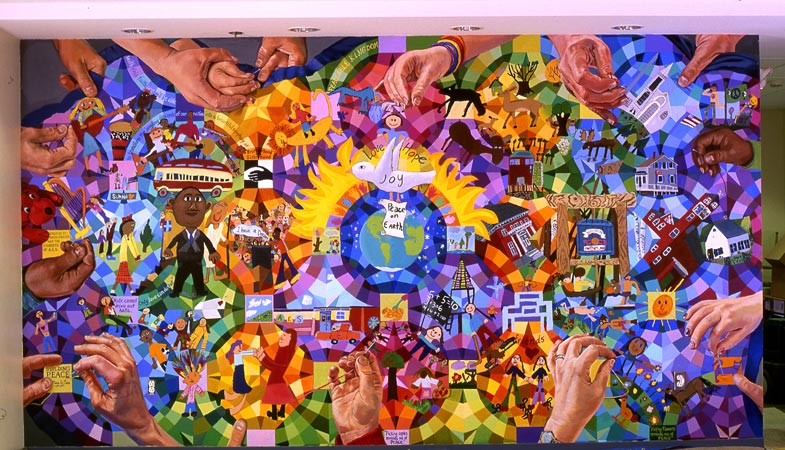
Just what were we thinking? We were thinking that there is much in the world that needs our prayer, especially the war in Syria. So we planned a brief prayer vigil this evening at our church. We hoped it would be a time for folks to pause and pray for peace in community.

What we weren’t thinking about was the children, namely our own. With Nathan leading the prayers and me being there to help lead some hymns a cappella, our children would need to be there as well. And so as it has been before and will likely be again, our children were the only children present.

We thought an intimate setting would be ideal, so Nathan arranged chairs in a circle in the front of the worship space, between the altar table and pulpit. It’s a lovely space for singing. He put candles on the floor and colorful crosses. The setting was a lovely combination of cathedral and living room.

There were just enough chairs set up for the number of people who came, including two for our two boys (the toddler’s seat was free: my lap). And as you can imagine, without pews to spread out on and being up front near all the cool churchy furniture, the kids went a little nutso. Many moments were frustrated and I had to leave the circle more than once.

Yet as I reflect more on this half hour of chaotic peacefulness (I do think that juxtaposition is possible), I realize just how much these children added, not detracted from my prayer.

Yes, my five year old squirmed and ran off, but he danced. In so many cultures, music and dancing are the same word; they cannot be separated. So when Luke left his chair and started dancing around the altar, I wonder if he gets something the rest of us have forgotten.

Yes, the toddler cried, but she sang.  When I sat her down on the pew and gave her a hymnal, she opened it and sang a song without words for two entire stanzas of FINLANDIA (and bobbed her head in rhythm for emphasis).

Yes, the seven year old was unfocused much of the time, but he prayed. During the Lord’s Prayer, his boy soprano voice could be heard clearly, a needed balance to our adult monotones.

Yes, the seven year old interrupted the pastor (dad) before we sang Psalm 46. But he participated. He just wanted the rest of us to wait until he found his page and took off his coat because he was hot.

Yes, they interrupted peace, but they shared peace. Our shy eldest hardly ever wants to share the peace of Christ in worship by shaking hands. In this small, intimate setting, he freely shared it.

Yes, it is hard taking children to worship. I was reminded of this reading a line from a mentor, Paul Westermeyer, this evening:  ‘The discipline of worship, like training for a marathon, requires stretches of boredom if there are to be moments of insight and the deepest joys and sorrows”  (Rise, O Church: Reflections on the Church,Its Music and Empire, Morningstar Music Publishers, 2008), p. 20.

For parents with children, worship can be more frustration than boredom, but like training for a marathon, we can be worn out. Especially when caregivers of children get the sense that children need to be “seen and not heard” so that the adults, the important ones, can get on with what’s important.

But then there are these moments when we get our second wind, a generous dose of the Holy Spirit.  It’s in such moments that I am reminded of why Jesus welcomed the children. They teach us about how the Spirit speaks/sings to us in distracted moments of chaos as well as in prayers for peace. 

Friday, July 19, 2013

Kinship at the Curve


When Nathan and I named our firstborn Thomas, we had in mind the apostle. We didn’t think for a minute about a blue steam engine that talked with a British accent. But folks who know us at all know about Thomas and his trains. Railroad enthusiast would not be a strong enough description.

As a parent, I’ve wondered about his infatuation a lot. His dad loved trains, so his interest makes sense, but I wonder about whether this train passion will flourish as he grows. Is it a phase? It’s hard to tell, but today I had a glimpse of what could become of his love of all things train.

We began the tradition of "adventure days" today. A friend shared with me this great idea of planning an adventure and not telling the kids where we were going ahead of time. When we arrived in Altoona, Pennsylvania at the Railroad Museum, Thomas leapt out of the car. No doubt… he was thrilled. Even better, a trip to the famous Horseshoe Curve.

When we arrived at the curve, there was a teenage boy next to the fence where you can watch the trains. He had a tripod set up, a camera around his neck. Though he was dressed  in shorts and a t-shirt like an “ordinary” teenager, I could tell this guy meant business. After a train came by, he started up a conversation with us and I was mesmerized. It was like time travel, perhaps a glimpse of a teenage Thomas. This young man was talking about paint schemes on locomotives, what engines were retired and when, when the next mixed freight should come around the curve. Wow… this guy was really into trains. And yes, that’s what he does on the weekends, especially in the summer. He goes around and watches trains, takes videos and pictures. I overheard his grandparents talking at the picnic table nearby and they, too, are into trains. They seemed very proud of their grandson’s passion.

I don’t know much about heritage units and 4-4-0s and the like, but I was moved at the ease with which Thomas talked with this stranger. Although  he struggles with meeting new people some of the time, a common interest encouraged him to share. The older and younger boy had a common passion, much I like I have with other church musicians. It’s about being with others who get you, who understand what makes you tick.

I don’t know where Thomas’s train passion will take him. He mentioned before bedtime that he wants to go back to the curve and pack breakfast, lunch and dinner and watch trains all day. “Sure, “ I said. “We’ll go back.” 

Wednesday, July 3, 2013

Alma Mater


These past few days I have been attending the biennial conference of the Association of Lutheran Church Musicians, held this year at my alma mater, Valparaiso University. I consider myself a proud alumnus. It is refreshing to walk the campus, to greet former teachers, to worship and sing in its grand chapel.

Such pride was tempered by a stroll through the campus bookstore. As deeply as I respect this institution and so many people connected with it, I have to be honest: I cannot purchase many of the items in their bookstore.

I was looking for a t-shirt to bring home for my youngest daughter. And sure, there were a few that had simply had the name “Valparaiso University” printed on the front. But the majority of them also had the imprinted symbol of the university’s sports, the crusader. This is what I cannot purchase.

One of the topics being addressed in the plenary sessions this week is the issue of the “religious nones” or the “religious alls” as one presenter phrased it more positively. A refrain we kept hearing is that many young people cannot associate with some segments of Christianity regarded as exclusionary. Bearing that in mind, I am back in that bookstore. Here this institution continues to brand itself with an image most exclusionary, a part of Christianity’s past that seems too violent to be promoted on a shirt, mug or bumper sticker.

Valparaiso is not the only home of the crusaders, of course.  I live less than ten miles from Susquehanna University, another liberal arts university with roots in the Lutheran church. Their sports players are also crusaders. And there are more .

I confess that I am not a historian professing detailed knowledge about the crusades. Any war takes two parties (at least) and some have proposed that those medieval Christians were acting in defense. Yet no matter the circumstances, when we endorse the crusader we are, in part, endorsing holy war. No swords becoming plow shares here.

If we are to seriously wrestle with Christianity and how it is perceived in our culture, perhaps starting with our college’s mascots wouldn’t be a bad idea. Because if our Christian colleges sports teams are battling with one another under the name of a holy war, it cannot help but shape us, even if it’s just by buying a shirt in a bookstore.

Thursday, May 9, 2013

Lifted Up, Loving Now


Today, forty days into the Easter season, the Church marks “The Ascension of Our Lord.” I have noticed some Facebook friends have commemorated this day by posting images such as these:


Ascension of Christ by Garofalo, between 1510 and 1520.


Jesus is ascending as we stand by, gazing upward. In the case of the second picture, it looks like we have photoshop to thank for the chuckle and the challenge.


Then there this next image that I couldn’t help but notice every time I worshipped at Calvary Lutheran Church, Winger, Minnesota, the church where my sons were baptized. 


I find it fascinating that many churches prominently display artistic renderings of the ascension yet aren't quite sure what to make of it. Some hold worship services on this day, others move the celebration to the nearest Sunday, still others avoid it all together.  

Laurence Hull Stookey in Calendar: Christ's Time for the Church notes that “current understandings of the universe, buttressed by the reign of reason in Western thought, have caused the ascension to become a large question mark for most Christians. It used to be supposed that heaven was a few thousand feet up in the air; now that we know something of the scope of the universe, this is manifest nonsense.”  One reason the ascension is such a question mark is our proclivity to separate faith and science. (For a hot-off–the-press treatment of this, see The Collapse of the Three Story Universe by Daniel Wolpert). If we no longer believe that heaven is “up there” and hell is “down there,” how can we wrap our minds around Jesus ascending into heaven?

Stookey continues: “That contemporary people should ask such questions is unavoidable. That the contemporary church has dealt with them only by silence is unforgiveable.” He goes on to commend the ascension not for its scientific actuality or what it means to be in Bible times with Jesus, but for its rich meanings for faith here and now.

In the spirit of not avoiding the ascension, I offer two experiences that when juxtaposed with ascension day, might yield another angle on what it all means.

Experience #1: We are lifted up


I was doing some work for a worship planning resource this morning when I read from the prophet Isaiah, a passage chosen for the first Sunday after Christmas, Year A.

I will recount the gracious deeds of the Lord…..
Surely, they are my people, children who will not deal falsely;
And he became their savior in all their distress.
It was no messenger or angel but his presence that saved them; in his love and in his pity he redeemed them; he lifted them up and carried them all the days of old.
(Isa: 63:7-9)

The Lord lifts us up; we are carried. It is not that Jesus ascends and leaves us orphaned to watch the rocket launch. I think more often it is us who are being lifted with him, like the children Jesus took in his arms, lifting them and claiming they are welcomed. We are not lifted to escape the depths nor heights of human experience, but to experience them more fully. God’s presence through Christ’s Spirit carries us more completely than we can comprehend.

Experience #2:  And so we lift others up

Also this morning I commented on a Facebook message thread questioning the “cry it out” method of sleep training for infants. It's a thorny topic with strong views on either side. One can make a scientific claim against it as the American Psychological Association has done. But my reasoning for not endorsing it is theological.  God comes to us, overflowing in mercy, promising to lift us up and hold us, to wipe every tear from our eyes. Although this is contrary to some belief, infants are not sitting in the crib figuring out how to trick mom or dad into coming and picking them up. “Ha, ha… got em’ again.” Hogwash. They are babies. They cry. And they cry to be soothed and held, they need to be lifted up and carried, to be assured that they are secure and loved. Perhaps as parents and caregivers we are lifting them up to reveal the presence of the Spirit, here and now.

The ascension affirms the boundless presence of Christ, breaking into our limiting, controlling ways. The words of Brian Wren challenge us when we are led to believe God is “up there” looking on us “down here.” Wren continually revised his hymns. The following stanza is not found in the most recent hymnal of my denomination, the Evangelical Lutheran Church in America.

Not throned afar, remotely high, untouched, unmoved by human pains,
But daily, in the midst of life, our Savior with the Father reigns.
(Christ is Alive, Stanza 2, Lutheran Book of Worship, 1978))

Would God keep lifting us up by grounding us more firmly in the here and now and by giving us the strength to lift up one another. That is my prayer this Ascension Day.